
 vn
vn en
en ja
ja ko
ko zh
zh


Mường Lay in My Memories
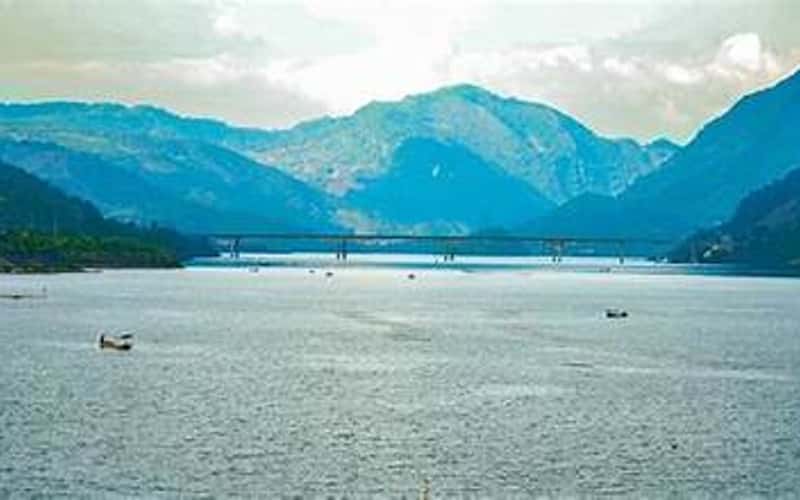
Mường Lay immediately draws you in with the dreamy beauty of its expansive lake region. It's a place where majestic mountains and winding rivers gently blend, crafting a serene and utterly captivating landscape.
The Peaceful Beauty of Mountains and Rivers in Harmony
Though covering an area of less than 12,000 hectares, Mường Lay town sits in a narrow, long valley where three waterways converge: the Đà River, Nậm Na River, and Nậm Lay stream. When the water level of the Sơn La Hydropower Reservoir rises over 200 meters across an expansive area of more than 100 acres, Mường Lay transforms into a poetic reservoir region. Stopping here, one feels a profound connection between the present and the past.

Bản Xá Bridge over the Đà River.
If you have the chance to explore the reservoir area, travelers can visit Lai Châu province to see and learn about the former residence of Thái King Đèo Văn Long, and observe the cage fish farming models of the local people. This area also consistently attracts those who love exploration and adventure, offering activities like fishing on the Đà River, mountain climbing to discover the Bản Bắc cave, or trekking through the forest to visit villages nestled on steep mountain cliffs. From Mường Lay to Lai Châu, you can embark on a poetic journey starting from the new Hang Tôm Bridge, passing through Chăn Nưa, then to Pa Tần - Phong Thổ, covering a distance of over 100 kilometers. The Nậm Na River winds along the old road's serpentine curves. Many sections of the river suddenly broaden, stretching to the mountain cliffs and the horizon, where once there were rice fields, bathing spots for villagers, or fertile ground for buffalo and cows to graze amidst the evening forest bell sounds. From a distance, you can see villages with charming stilt houses perched on high ridges, appearing and disappearing amidst drifting misty clouds. Occasionally, a dugout canoe glides across the river, like a shuttle weaving through an embroidered brocade, adding a poetic touch to this mountainous region.

Beyond its famous stilt houses, Mường Lay is also adorned by its bridges. Among them is Hang Tôm Bridge, once hailed as "Indochina's First Bridge" – the largest bridge in Indochina. This bridge gracefully spanned the banks, connecting Điện Biên and Lai Châu. Just like the residence of Thái King Đèo Văn Long, the entirety of the old Hang Tôm Bridge now lies submerged in the deep reservoir. Standing on the new Hang Tôm Bridge, one can't help but feel a nostalgic connection to the past. Mr. Khăm Ching, our guide in Mường Lay, recounted that beneath the old Hang Tôm Bridge was a shrimp cave, home to countless blue-clawed prawns, which served as a food source for the Thái King and the people of Mường Lay. Mường Lay captivates not only with its poetic natural landscapes but also with the diverse and unique cultures of its ethnic communities. Each ethnic group here possesses its own distinct cultural identity, creating a rich and vibrant tapestry of beauty. Mường Lay is considered the capital of the White Thái people in Điện Biên, the birthplace of charming hat dances, scarf dances, and fan dances. Many Thái dancers of old were even selected by Thái King Đèo Văn Long to perform at his residence during celebrations or receptions for Western officials from the motherland. After the liberation of Điện Biên, these dancers were freed from their "caged fish, caged bird" existence, passing their remarkable skills down to future generations...

Row of stilt houses in Mường Lay.
Today, visitors to Mường Lay can also explore traditional craft villages, such as brocade weaving and ethnic instrument making in Na Lay ward, wood production and processing in Sông Đà ward, or household wickerwork in Lay Nưa commune. In the evening, settling into a traditional stilt house, one can savor enticing local specialties like *canh bon*, *nộm hoa ban*, *gỏi*, *lạp*, and various grilled fish dishes. Of course, the regionally famous *cá lăng* (Hemibagrus catfish) and Đà River prawns are absolute must-tries. Amidst the intoxicating aroma of corn wine carried on the breeze, you can join in the xòe dance, and let your soul drift with the sweet singing voices of the Thái girls. Leaving the legendary Hang Tôm Bridge, our car passed through Mường Lay almost unnoticed, as the history of name changes has muddled the memories of place names along National Highway 12. The former Lai Châu town of old Lai Châu is now renamed Mường Lay; while the Mường Lay of yesteryear is now called Mường Chà.

As the faint sunlight slowly descends from the high mountain peaks, Mường Lay town appears gilded in golden light during sunset. Standing on Bản Xá Bridge and gazing down at the Đà River, my heart recalled the writings of author Nguyễn Tuân. But the legendary Đà River is not merely portrayed as a malevolent force during flood seasons; it has also, for generations, sustained the Thái people of this region with an abundance of shrimp and fish, filling their boats after conquering nature's challenges. These bountiful gifts from the Đà River are specialties that welcome distant guests, tasted once and remembered forever. Our car drove along the Đà River under the golden moonlight, which seemed to pave the road like a soft silk ribbon, passing closely built stilt houses with stone-tiled roofs. On the gables, several young Thái girls with fair skin and soft hair, bathed in moonlight, stood gracefully amidst the soft, thin mist.
Farewell, Mường Lay; farewell, Đà River – we hope to return another day.
Dien Bien 5069 view
Update day : 19/10/2023
Source : baodienbienphu.com.vn Affiliate links




Monuments close by
See all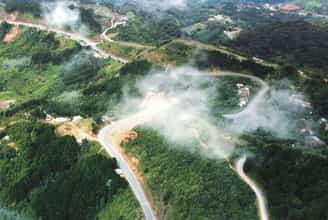
Pha Din Pass
Nearly 100 km from Dien Bien Phu city, Dien Bien province, Pha Din Pass is the boundary between Son La and Dien Bien provinces. The name Pha Din Pass comes from the Thai word "Pha Din" in which "Pha" means "Heaven", "Din" means "Earth", meaning this is the junction between heaven and earth. The pass is 32km long and is located on Highway 6, part of it in Phong Lai commune, Thuan Chau district, Son La province and part of it in Toa Tinh commune, Tuan Giao district, Dien Bien province. The starting point of the pass is 66km west of Son La town, while the end point of the pass is about 84km from Dien Bien city. At Pha Din slope, she carried the burden. Lung Lo Pass, brother and sister sing. Even though bombs and bullets shatter bones and flesh. Don't get discouraged, don't regret your youth. The optimistic poem sketches the spirit of a fiery time 65 years ago. Pha Din Pass has an altitude of over 1,000m above sea level, the terrain is very dangerous with one side being a steep cliff, the other side being a deep abyss "a thousand meters up, a thousand meters down". During the Dien Bien Phu campaign in 1954, Pha Din Pass was one of the important arterial routes transporting weapons, ammunition and food to the front and it became a symbol of bravery for more than 8,000 young people volunteered to "Determine to die for the country." In order to block the Viet Minh's reinforcement line into Dien Bien Phu, for 48 days and nights, General De Castries sent planes to hijack Route 6, in which Pha Din Pass was one of the points that suffered the most bombs and bullets. At the top of the pass there is still a stele recording this historical mark. On the stele, it is written: "This is the place that suffered the most from air bombardments by the French colonialists to block our supply of weapons, ammunition, food, and food to serve the Dien Bien Phu campaign." ". By 2005, the government decided to invest in upgrading National Highway 6 to the Northwest. The new Pha Din Pass was built along the mountainside on the left side of old Highway 6, 26km long. The new pass route has been put into use to help vehicles circulate more safely. The old pass route is now for indigenous people or adventurous tourists to conquer and explore. Source: Dien Bien Province Monuments Management Board
Dien Bien
8066 view
Rating : National monument

Command bunker of Dien Bien Phu stronghold group
Ham Do Castries (local people's name) full name is Dien Bien Phu stronghold group command post, also known as GoNo command post, located in Thanh Truong ward - Dien Bien Phu city - Dien Bien province. . During the Dien Bien Phu campaign, GoNo Command Post was located in the center of the stronghold group, 2m underground and in a lower position than the direction of our army's attack. This is the headquarters of a giant military group that France and the US are very proud to consider the strongest fortress ever in Indochina. GoNo command post is given priority to have solid and solid construction materials capable of resisting enemy firepower, in addition to being protected by all the most modern weapons and means of warfare at the time. then. The structure and arrangement of the basement are still kept intact with a length of 20m and a width of 8m divided into 4 compartments used for both work and accommodation. Surrounding the bunker is a barbed wire fence with alternating mines and 4 defensive tanks in 4 directions. In this basement, De Castries solemnly welcomed many high-ranking officials from England, France, America and dozens of writers and journalists from the Western journalism industry. It was also here that De Castries and his entire General Staff plotted to destroy our main army, but he also had to go crazy many times to deal with enemy attacks. Vietnam People's Army. At 3:00 p.m. on May 7, 1954, our campaign command ordered a general attack on the entire front to destroy the entire group of Dien Bien Phu strongholds. After destroying key strongholds around the central division, our troops crossed Muong Thanh bridge and headed straight to Gono Command. At 5:30 p.m., comrade Ta Quoc Luat, commander of company 360, regiment 209, regiment 312, and 2 assault soldiers captured General De Castries and the entire French command, holding the flag "Determined battle, Quyet". Victory" flew high above the tunnel roof in the middle of the historic summer afternoon of May, signaling the day of complete victory for our army and people. Today, the Ham Do Castries relic along with other relics in the Dien Bien Phu historical relic complex have been invested in by the Party and State to restore and renovate to serve domestic and foreign visitors. Part of promoting the value of the Dien Bien Phu historical victory relic site and also to propagate and educate the heroic Dien Bien Phu tradition. Source: Department of Culture, Sports and Tourism of Dien Bien province
Dien Bien
7607 view
Rating : Special national monument

Muong Thanh Bridge
Muong Thanh Bridge, also known as "Prenley" bridge by the French military, is a bridge across the Nam Rom River, built by the French. The bridge is a military project located in the central subdivision of the Dien Bien Phu base group. On November 20, 1953, the French Colonialists chose Dien Bien Phu to build the strongest stronghold group in Indochina at that time with 49 strongholds divided into 3 subdivisions: Northern Division, Southern Division, also known as is the Hong Cum subdivision and the Central subdivision is the most important subdivision. Because the terrain of Dien Bien Phu is a wide basin, surrounded by high mountains, in the central battlefield there is the Nam Rom river flowing through dividing the central area into left and right banks, so the Communication from the central command post with the base groups on the eastern and northeastern hills encountered many difficulties. To solve those difficulties, the French army built Muong Thanh bridge across Nam Rom river. Muong Thanh iron bridge is a pre-made bridge that was shipped from France and assembled in Dien Bien. The entire bridge is 40 m long and 5 m wide. On both sides of the bridge are simple supporting iron bars, without a middle shaft. The bridge floor is paved with wood, and underneath are iron beams that are very firmly linked together to ensure a load of 8-15 tons. To protect this vital bridge, the French arranged bases 509, 508 and 507 on the eastern bridgehead, while on the western bridgehead they arranged a 4-barrel machine gun nest to prevent the enemy from attacking beyond. Cross the bridge to attack the central command post. With such a force arrangement, General De Cat hoped to maintain the bridge and maintain the gateway for reinforcements to the eastern and northeastern peak clusters of the Dien Bien Phu stronghold group. When war has not yet occurred, Muong Thanh bridge is a transport route for raw materials, ammunition, and barbed wire to serve the construction of defensive bases in the East and the Northern subdivision. During the general attack to destroy all the eastern heights at 4:00 a.m. on May 7, 1954, our troops destroyed the entire A1 base. At 2:00 p.m., Regiment 209, Division 312 launched an attack. Base 597 at the beginning of Muong Thanh bridge. The enemy at base 507 raised the white flag to surrender, took advantage of the victory, and rushed forward. Group 312 attacked and destroyed two bases 508 and 509 on the left bank of the Nam Rom river. At these two bases, the enemy resisted weakly and was quickly defeated. extermination. From the east, Regiment 209 advanced straight into the central area of Muong Thanh with Regiment 98 and Regiment 174 close to the central area. In the west, the 36th Regiment entered the last strongholds covering the enemy's headquarters. The 88th Regiment opened the way through the airport and straight into Gono's last lair. Wherever our troops fought, the enemy's white flag appeared, many enemy groups from bases and trenches flocked out to surrender their weapons. At exactly 5:30 p.m. on May 7, 1954, our army's Decisive War - Determined Victory flag fluttered on the roof of General De Cat's bunker, successfully ending the historic Dien Bien Phu campaign. This was the biggest victory in the long resistance war against the French colonialists and American interventionists, and also the most famous victory in the history of the Vietnamese people against foreign invaders. Initially, Muong Thanh bridge was built by the French after parachuting to occupy Dien Bien Phu. In the end, the bridge became a means of guiding the way for our soldiers to attack, planting the Decisive Victory flag on the roof of the bunker of defeated General De Cat. Source: Compiled by Department of Culture, Sports and Tourism of Dien Bien province
Dien Bien
7591 view
Rating : National monument
D1 Hill and Dien Bien Phu Victory Monument
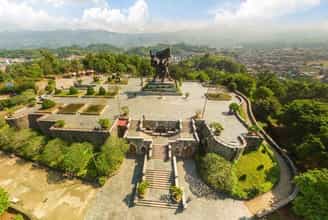
Hill D belongs to the Dominique cluster, the French colonialists built and turned this base into the frontline position of the eastern hills. Because the location of Hill D was to shield and protect the Dien Bien Phu Fortress Group Command Headquarters and Muong Thanh Airport, the French colonialists took advantage of the natural terrain to benefit them militarily to build the position. The defense position is extremely solid and powerful. Here, the French army arranged the very battle-hardened 3rd Battalion of the Algerian Regiment to occupy it. As for the Vietnam People's Army, capturing the Eastern peak range, including peak D1, is a very important task in the second attack of the Dien Bien Phu campaign. The unit responsible for destroying D1 base is Battalions 166 and 154 of Regiment 209, Group 312. At exactly 5:00 p.m. on March 30, 1954, artillery guns of the Vietnamese army simultaneously rained down on hill D1 and the eastern high points in the central area of Muong Thanh. Within 30 minutes, the 209th regiment captured D1 hill. The next morning, the French army counterattacked in conjunction with the air force to recapture the base. The battle took place fiercely after 2 days of complete control by the Vietnamese army. D1 hill base. After capturing hill cluster D, Vietnamese soldiers turned this place into a battlefield for the 209th Regiment's firepower, continuing to support other units to capture the remaining French bases. It can be said that the battle that took place on the eastern hills, including D1, was one of the important battles that contributed to the victory in the second attack of the Dien Bien Phu campaign. On the historic land of Dien Bien today, there are a number of monuments and bas-reliefs built to fully, realistically and vividly recreate the great battle of our army and people more than a few years ago. 6 decades, in which the Dien Bien Phu Victory Monument is the largest and only bronze monument in the project of works celebrating the 50th anniversary of the historic victory of Dien Bien Phu. Hill D1 relic was honored to be chosen as the location for the Dien Bien Phu Victory Monument, because the relic is located in the center of the city, has a beautiful terrain, from the relic you can observe the entire Dien Bien basin. Bien Phu. This was the tallest, largest and heaviest bronze statue cluster in Vietnam at that time. The statue was built with a height of 12.6m, mounted on a 3.6m high pedestal and cast with 217 tons of bronze. The Dien Bien Phu Victory Monument stands tall in the midst of historical Dien Bien and together with other relics such as: Hill A1, Muong Thanh bridge, Him Lam, Doc Lap, Ban Keo, Muong Phang.... has become The place is eternal with the country, a testament to the heroic history of the Vietnamese people in the thousands of years of struggle to build and defend the country; creating national identity, passing on heritage to future generations; Strengthen solidarity and attachment between generations of Vietnamese people and among ethnic groups in the area; It is one of the typical symbols for the desire for peace, friendliness, hospitality, always open to welcome friends and international tourists, and the spirit of cooperation and development towards the future. Source: Department of Culture, Sports and Tourism of Dien Bien province
Dien Bien
7488 view
Rating : National monument
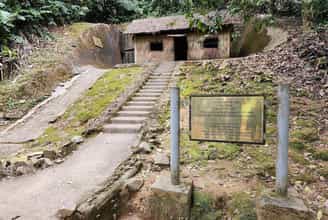
Dien Bien Phu campaign headquarters
Dien Bien Phu campaign headquarters is hidden in the old forest at the foot of Pu Don mountain in Muong Phang commune, Dien Bien district, nearly 40 km from Dien Bien Phu city. This is where General Vo Nguyen Giap often worked and rested during the Dien Bien Phu campaign, which achieved a "famous victory on five continents, shaking the earth". The Dien Bien Phu campaign command area was stationed in Muong Phang for 105 days from January 31, 1954 to May 15, 1954. With the arrangement of tunnels and camps into a continuous system, hidden in the jungle at the foot of Pu Don mountain, the important headquarters of the Dien Bien Phu campaign was guaranteed absolute safety... From this Command Post, going higher, standing on the highest point, you can observe the entire city of Dien Bien Phu, Muong Thanh valley and former strongholds of the French army such as Him Lam hill and Doc Lap hill. , D1 hill, C1 hill, A1 hill... The telephone switchboard tunnel helps the Campaign Command communicate with the infantry, engineering, artillery, and antiaircraft units at the front and the warehouse units, stations of the General Department of Supply, military medical system, The civilian fire line is behind the front. This is a direct communication network between the Campaign Command and the Party Central Politburo, Uncle Ho... From the tunnel through the mountain, connecting from General Vo Nguyen Giap's shack to Major General Hoang Van Thai's shack, to other locations such as the workplace of the Chinese military advisory group, the workplace of the Chief of Information Department. Hoang Dao Thuy campaign... all still seem to have intact traces of history... Next to the General's working and resting place is a shelter dug through the mountain. When the French army bombed heavily, the General worked and rested in this shelter. From the shack of General Vo Nguyen Giap to the shack of Chief of Staff Hoang Van Thai and the shack of military advisor Vi Quoc Thanh is a 69m long tunnel. The tunnel is 1.70m high, 1 to 3m wide, in the middle of the tunnel there is a meeting room with an area of 18m2 and 5 communication locations. Located 300m northeast of the Campaign Headquarters is where our army and people solemnly held a military parade to celebrate victory on May 13, 1954. In the Project to renovate the Dien Bien Phu Campaign Command Headquarters Relics, the Dien Bien Phu Relics Project Management Board implemented General Vo Nguyen Giap's idea of planning a campus on the old military parade grounds and placing a cluster of monuments commemorating the 55th anniversary of the victory of Dien Bien Phu. Along with the Dien Bien Phu Campaign Command Relics, the Victory Monument cluster at Muong Phang Park is also a stop not to be missed when coming to the Dien Bien Phu Campaign Command Relics. Local people often call this place by the familiar name "Memorial Monument". Source: Dien Bien Province Radio and Television Station
Dien Bien
7405 view
Rating : National monument
Nearby tourist attractions
See all
Dien Bien Phu victory relic site
The Dien Bien Phu Battlefield relic site includes 45 component relics. This is a historical space and also an outstanding tourism product, contributing to traditional education for the young generation, reminding Vietnamese people of the heroic memory of the Dien Bien Phu victory "illustrious in five continents, earth-shattering" while bringing economic value to the locality. During these historic days of May, many delegations flocked to Dien Bien Phu city (Dien Bien province) to visit the old battlefield on the occasion of the 65th anniversary of the Dien Bien Phu Victory (May 7, 1954 - May 7, 2019). 2019). There have been a lot of changes in the land that was once a fierce battlefield in the past, with the 56 day and night campaign of "cutting mountains, sleeping in cellars, pouring rain, squeezing rice" by our army and people, successfully ending the battlefield resistance. period against the French colonial invasion. The Dien Bien Phu Battlefield relic complex is now one of more than 100 special national monuments in the country and plays an important role in the tourism development of Dien Bien province. The Dien Bien Battlefield relic complex includes outstanding relics such as: A1 Hill, Doc Lap Hill, Hong Cum base, Him Lam, Muong Thanh bridge, Dien Bien Phu base group command tunnel (or Do tunnel). Sand), Victory Monument, Cannon Monument, Dien Bien Phu Campaign Headquarters... These relics have left a deep impression, attracting many tourists to visit when coming to Dien Bien. Located east of the center of Dien Bien Phu stronghold group, A1 hill has the most important position in the system of 5 hills protecting the center of Muong Thanh. Here, on the night of May 6, 1954, our troops dug a tunnel, placed an explosive weighing nearly 1,000kg and set it on fire. By the morning of May 7, 1954, our troops had complete control of A1 hill, paving the way for the final general attack on the stronghold group headquarters and achieving complete victory. Hill A1 is now a tourist attraction for domestic and international tourists with tunnels, trenches, blockhouses, and tanks preserved almost intact. Here, tourists can experience pushing bicycles, cooking with Hoang Cam stoves, listening to veterans tell stories... General De Cat's command bunker is located in the center of the Dien Bien basin. This is the basement with the working and resting rooms of General De Cat and the Dien Bien Phu base group command. This is also the place that marks the tragic defeat of an expeditionary army with the image of the commanding general and all officers under his command raising their hands to surrender and our soldiers raising the flag of determination to win and ending the war. Translating the history of Dien Bien Phu. Another relic that cannot be ignored along with the epic poems about Dien Bien soldiers is the artillery pulling Duong relic. This legendary route has entered the nation's history and become legendary. Using only human strength and rudimentary tools, but with patriotism and heroic spirit, our army and people opened routes on winding and dangerous mountain slopes to pull artillery into the battlefield. 20km from the center of Dien Bien Phu city is the campaign headquarters located deep in the Muong Phang forest. This was the headquarters of the Dien Bien Phu Campaign Command from January 31 to May 15, 1954. During the days here, General Vo Nguyen Giap made many important and historic decisions. Muong Phang Forest has become a symbol of the strength of the Vietnam People's Army and is called "General's Forest" by the people. In the complex of Dien Bien Phu Battlefield relics, a project that was born in peacetime but plays a very important role is the Dien Bien Phu Historical Victory Museum. This project was completed in 2014, on the occasion of the 60th anniversary of the Dien Bien Phu Victory. The museum has a shape that simulates the helmet of our soldiers in the past. This is where artifacts from the historical Dien Bien Phu campaign are kept, including 2 display areas: Outside, there are 112 artifacts that are weapons used by the Vietnam People's Army and the French army, inside. Displaying 274 artifacts and 202 documentary photos. The museum has contributed to promoting the value of the historical complex of Dien Bien Phu battlefield and is a highlight attracting tourists to Dien Bien.
Dien Bien
6936 view
From January to December
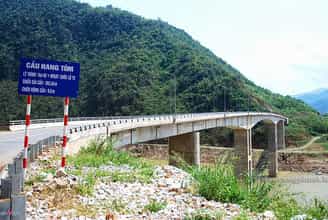
Hang Tom Bridge
The old Hang Tom Bridge was previously famous as the most beautiful cable-stayed bridge in the Northwest, connecting Muong Lay (Dien Bien) and Phong Tho, Sin Ho of Lai Chau. The reason the bridge is called Hang Tom is because this part of the river used to have too many shrimp. About 50m from the bridge, there is a "pool" of very cool water, shrimp from the Da River flock there to lay eggs, the whole stretch of the river is densely packed with shrimp. Every day, people take turns going up there to catch them and eat them. But the people around this area have an unwritten custom: each family can only arrest for about an hour before the other family continues. In the late 1960s, Hang Tom Bridge began to be built. That day, Chinese experts and workers also came to help us build the bridge. However, in 1968, China had a cultural revolution, and all its experts and workers withdrew home. Fortunately, the item considered to be the most difficult, the cable car, had been pulled, leaving only the finishing stages remaining. But it was not until 1973 that Hang Tom Bridge was inaugurated. That day was truly a big festival for tens of thousands of Northwest people. Thousands of people came from all over to eat, eat rice balls, and walk for several days to see with their own eyes and once cross the dream bridge. Tom Cave is a highlight for the Northwest region. Because of the majestic and wild beauty of Hang Tom Bridge, in recent years, tourists, Westerners as well as ours, have flocked here, especially since the emergence of the backpacking tourism movement. In November 2012, Son La hydroelectric power station flooded, the entire old Muong Lay town, including Hang Tom bridge, sank deep under Song Da lake, ending 40 years of operation of the historic bridge. Right near the old Hang Tom bridge location, a new bridge was built to replace the task, 70m higher than the old bridge.
Dien Bien
7085 view
From January to December

Pha Din Pass
Pha Din in Thai is called "Pha Din", in which "Pha" is heaven, Din is "earth". The name of this pass means the place where earth and sky intersect - the name is enough to help people imagine the remoteness and danger here. Pha Din Pass is about 100km from Dien Bien Phu city. This is considered the boundary between Dien Bien and Son La provinces. Pha Din is located at an altitude of 1000m above sea level, with a total length of about 32km. The starting point of the pass is 66km from Son La City, and the end point is about 84km from Dien Bien Phu City. Pha Din, along with O Quy Ho, Khau Pha, and Ma Pi Leng, make up the four legendary passes of the Northwest highlands. Tourists from far away who want to conquer this great pass need to come to Hanoi by bus, train or it is best to book a plane ticket to Hanoi. From Noi Bai airport, visitors can book an airport shuttle on Traveloka to get to the city center. From Hanoi, to Son La - the starting point of Pha Din Pass by sleeper bus, limousine or motorbike. This pass is located on Highway 6, connecting the two provinces of Son La and Dien Bien. Travelers starting from Hanoi will travel along Highway 6 through Moc Chau - Yen Chau - Mai Son - Thuan Chau plateau to reach the starting point of Pha Din pass. If you depart from Dien Bien Phu City, you will follow Highway 279 towards Tuan Giao district. Each season, Pha Din Pass has a different beauty. But the most beautiful seasons in Pha Din are spring and summer. Spring is the season when wild flowers bloom. There are pink peach blossoms, pure white plum blossoms, and banyan flowers filling the sky. March is the season when ban flowers bloom - a typical flower of Dien Bien province and is also considered the most beautiful season by backpackers. Summer in the delta provinces is scorching hot, but the climate in Pha Din is cool and pleasant. Winter with drizzle, cold weather and more dangerous roads is not the ideal season to conquer Pha Din. In addition, from May to August is the rainy season in Dien Bien. Before starting your journey, you should closely monitor weather developments. Because the Pha Din area is a red soil mountain, not a limestone mountain. When there is a lot of rain, extremely dangerous landslides can occur. Most tourists and backpackers come here to satisfy their adventurous spirit. The rugged mountain pass and majestic nature here seem to have a strange hypnotic power. Looking back from afar, the long pass road curves like a rope suspended between mountains and hills. The terrain here is extremely dangerous with a cliff on one side and a deep abyss on the other. The highest point of Pha Din pass is 1,648m above sea level. The slope of the pass ranges from 10% to 19%. The mountain pass is zigzag with 125 dangerous curves, A-shaped and Z-shaped curves with a curve radius of less than 15m. Going from the starting point to the top of the pass, each natural picture slowly opens, both majestic, breathtaking and poetic. At the foot of the pass are scattered villages. Halfway up the pass, clouds covered it. Looking down from the slope of the pass is the vast Muong Quai valley. Approaching the top of the pass, there is only the deep sky and majestic, vast mountains and forests. When conquering Pha Din, don't forget to stop to admire the scenery at Ang Nua valley or check in at Pha Din Pass - a 50ha tourist area built by Pha Din cooperative. Vitality is present throughout Pha Din pass. On the conquering route, visitors will encounter images of highland markets when passing through Phong Lai commune, Thuan Chau district, Son La province or Toa Tinh commune, Tuan Giao district, Dien Bien province. People gather at the market to buy and sell agricultural products, medicinal herbs, and mountain and forest products. Tourists can also stop to buy some to take home as gifts. What makes Pha Din Pass more special than the other three great Northwest passes is that this pass is associated with the famous Dien Bien Phu campaign in five continents, shaking the earth. During the resistance war against the French, Pha Din was the route to supply and transport artillery to Dien Bien Phu and became a symbol of the brave spirit of 8,000 young volunteers. To block this supply route, the French army sent planes to bomb Route 6 continuously for 48 days and nights. Among them, Pha Din Pass was one of the two places that suffered the most from bombs and bullets. Now, Pha Din Pass has been recognized as a National Monument, a testament to the nation's history.
Dien Bien
6918 view
From January to December

Pa Khoang Lake
Pa Khoang Lake is located in Pa Khoang commune, City. Dien Bien Phu; About 8km from Highway 279 and from the city center. Dien Bien Phu is nearly 20km to the Northeast. In the language of the Thai people, Pa Khoang means "bamboo forest". Mr. Quang Van Viet, Chairman of the People's Committee of Pa Khoang commune, said: In the past, countless bamboo trees grew around the lake. Thai people here have a funny saying that "look up and see the sky, look down and see bamboo". Local people often use bamboo to make fishing rods and some household items. In addition to ensuring irrigation for 5,000 hectares of Muong Thanh fields with 2 rice crops, Pa Khoang lake also regulates the climate, limits the harmful effects of floods, and stores water for two hydroelectric projects Thac Bay and Na Loi. With the advantage of diverse vegetation, the forests around the lake are rich in all kinds of animals; Many species of plants and animals floating and under the lake bed. In 2004, on the occasion of the 50th anniversary of the Dien Bien Phu victory, the road leading to Pa Khoang Lake was paved. Also at this time, 4 motels, both luxurious and rustic, with nearly 100 rooms were opened; Cultural villages of the Thai and Kho Mu ethnic groups were also deployed with a total area of over 1,000 hectares. To get to Pa Khoang Lake, visitors can move from Highway 279 along Highway 279b into Muong Phang commune. Or you can follow the road southeast of the city. Dien Bien Phu passes through Ta Leng commune. These two routes lead visitors through winding roads along the lake, occasionally appearing behind the forest canopy on the clear blue surface of Pa Khoang Lake... Visiting Pa Khoang Lake, visitors can row a boat on the rolling waves, creep into every corner of the islands, and discover the magic of the natural world. Visitors can also walk through the forest to enjoy the scenery and visit villages of the Thai ethnic group. The people here are very friendly and hospitable; Visitors will be invited to attend cultural exchanges, enjoy art and culinary dishes, such as sticky rice, bamboo-tube rice, grilled fish, smoked meat... In winter, mist covers the lake surface, creating a magical watercolor painting. Summer comes, the lake surface is clear and gentle, reflecting the mountains, clouds, sky and dark green forests. In 2015, the Prime Minister approved the "Master plan for development of Dien Bien Phu - Pa Khoang National Tourist Area, Dien Bien province until 2020, vision to 2030". The general goal of the planning is to develop the Dien Bien Phu - Pa Khoang Tourist Area by 2020 to basically meet the criteria of the National Tourist Area; By 2030, it will truly become a National Tourism Area with a system of synchronous and modern technical facilities; is a highlight and milestone on the tourist route through the Northwest region, creating a driving force to promote tourism and socio-economic development in Dien Bien province.
Dien Bien
6847 view
From January to December

The westernmost point of A Pa Chai
A Pa Chai is located in Sin Thau commune, Muong Nhe district, 250 km from Dien Bien Phu city, is the westernmost point of the country, where there is a landmark dividing the boundary between the three countries Vietnam - Laos - China. This is called the border junction located on the top of Khoang La San mountain, 1,864m above sea level, welcoming many tourists every year, especially young people from all over the country to visit. , conquer. Previously, A Pa Chai was considered a difficult landmark to conquer because the road to the landmark was difficult, having to cross three head-high thatched grass hills, cross forests, wade streams, and climb high mountains, which took four to five hours from The border guard station has just arrived. It's different now. In 2018, Dien Bien province completed the concrete road along the cliffs and built steps, making it easier for visitors to conquer the milestone even though they still have to walk a few kilometers of small, steep and climbing concrete roads. 500 steps to reach the landmark. The border junction marker placed on the top of the mountain is triangular in shape, with three sides facing three directions, each side has the country's name engraved in its own national language and the national emblems of the three countries of Vietnam, Laos and China. From the high point of the westernmost point of the country, looking into the distance is a vast space, majestic mountains and forests. The three-sided landmark dividing the boundary of the three countries Vietnam - Laos - China shimmers in the sunlight. Emotion and national pride surged.
Dien Bien
7548 view
From January to December
 AI Travelviet